Download IVISION Catalog

 01
Capture the transition
Assess a view that keeps the person's movement and nearby floor area visible.


A possible-collapse workflow concerns the change in posture, not simply finding someone already on the ground. Where supported, a sequence can help a reviewer distinguish an abrupt transition from sitting or bending. Video alone cannot establish why it happened or whether the person has a medical condition.
A supported temporal detector and event-media path must be confirmed. This is not a medical diagnostic service.
Discuss collapse-event review
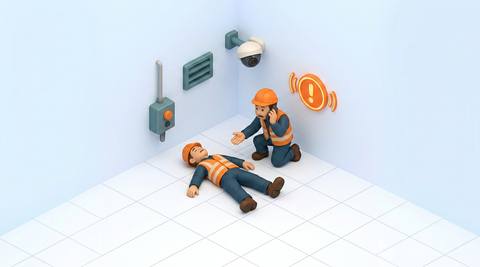
 Without IVISIONStandard CCTV feed
 With IVISIONIllustrative event overlay
The Process
A posture transition is a cue for a welfare response. Retain useful sequence context for a proportionate welfare check.
01Assess a view that keeps the person's movement and nearby floor area visible.
 02
Compare representative sitting, bending and floor-work examples with the proposed event criteria.
 03
If supported, inspect the lead-in and resulting posture rather than relying on a single frame or label.
 04
Follow the site's welfare or emergency procedure and record the review outcome. Confirm event delivery independently.
Explore Your Options
| Dimension |  Possible Collapse Observation |  Person Down / Collapse Detection |
|---|---|---|
| Observation |  A visible transition from upright to a low or ground-level posture. | A person appears prone, seated unusually low or motionless near the floor. |
| Event criteria | A supported temporal model flags a transition matching agreed criteria in the selected view. | A supported detector observes the agreed posture for a validated period. |
| Monitoring setup | Define permitted zones, observation periods and expected activities such as floor work; verify available pre-event context. | Confirm allowed tasks, observation duration and routing. |
| What it cannot establish | Sitting, kneeling, occlusion and camera motion can resemble a collapse. The cause, injury and medical status cannot be diagnosed. | Cannot establish consciousness, injury or cause. |
| Practical outcome | Keeps the preceding movement and resulting posture together for a responsible reviewer. | Help responders locate a situation requiring a welfare check. |
Illustrative demonstration
Example footage and simulated events explain the review workflow. They do not measure detector performance.
 Sites overview
No matching events.
People EventsProvides the broader person-down context after a posture change.
Read More
 People Events
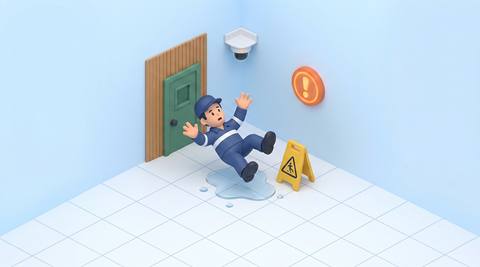
A fall has its own motion criteria and must not be assumed from a low posture.
Read More People Events
Prolonged stillness is a different observation from a transition.
Read MoreEXPLORE WHAT’S POSSIBLE
01 / 04 · POSSIBLE COLLAPSE OBSERVATION
A person abruptly moves from standing to the floor.
Example event: A possible posture-transition event is presented with its camera time.
Operator response: The operator reviews the sequence and arranges a welfare check.
Practical value: The response uses location and sequence context.
Discuss this capability02 / 04 · POSSIBLE COLLAPSE OBSERVATION
Technicians regularly kneel to inspect equipment.
Example event: A low-posture transition resembles the candidate criterion.
Operator response: A supervisor checks the work context and records an expected movement.
Practical value: Routine work is not automatically labeled an emergency.
Discuss this capability03 / 04 · POSSIBLE COLLAPSE OBSERVATION
A visitor goes down outside the clinical monitoring system.
Example event: A supported camera workflow raises a possible transition for review.
Operator response: Staff follow the local assistance procedure without treating the label as a diagnosis.
Practical value: The observation can direct a human check to the relevant area.
Discuss this capability04 / 04 · POSSIBLE COLLAPSE OBSERVATION
Use an unobstructed view of the expected movement area and floor.
Visibility: Crowds, furniture and missing frames can hide the transition.
Configuration: Confirm temporal analysis, event media and any pre-event recording support; these are not universal catalog features.
Privacy: Exclude private spaces and restrict sensitive welfare footage to authorized reviewers.
Human review: Use trained human judgment and established emergency procedures; do not wait for camera analysis when help is visibly needed.
Discuss this capabilityFrequently asked questions
Reviews an observed transition from an upright posture toward the ground that may warrant a prompt welfare check.
Person-down review concerns a resulting low posture. Collapse review concerns the observed transition toward it.
No. A camera observation cannot establish a medical cause.
A still image cannot show the transition. Confirm that the supported workflow provides the necessary sequence context.
Include representative floor work during assessment and keep human review in the response path.
Find your fit
Keeps the preceding movement and resulting posture together for a responsible reviewer. For Security operators, Facility response teams, Welfare coordinators.
Workflow to discuss
Possible Collapse Observation + Distinguishes a posture change from an already stationary person.
Discuss a camera view, a monitoring question and the review process your team needs.