Download IVISION Catalog

 01
Prepare the view
Cover the cluster area and surrounding circulation.


A group formation can change service demand and circulation even when the overall headcount is modest. Define size and persistence criteria, then interpret the cluster alongside bookings, queues and scheduled activity.
Catalog workflow. Confirm detector availability, permitted use and event delivery for the proposed deployment. Website examples are illustrative.
Assess group-flow analytics

 Without IVISIONStandard CCTV feed
 With IVISIONIllustrative event overlay
The Process
Count the formation without inferring relationships Plan space and service around observed formations.
01Cover the cluster area and surrounding circulation.
 02
Validate grouping against ordinary passing crowds.
 03
Review formation duration and aggregate size.
 04
Adjust assistance or layout after checking the operational cause.
Explore Your Options
| Dimension |  Gathering / Grouping Detection |  Queue Length & Wait Time Estimation |
|---|---|---|
| Observation |  Several people cluster within a defined region. | People occupying a defined waiting route. |
| Event criteria | A supported grouping method meets size and duration criteria. | Supported analysis counts the queue or links waiting-entry and service-exit observations. |
| Monitoring setup | Confirm spatial grouping, persistence and event schedules. | Confirm queue geometry, abandonment and service-point definitions. |
| What it cannot establish | Cannot establish social relationships, shared identity or intent. | Cannot infer customer satisfaction or measure unseen waiting accurately. |
| Practical outcome | Explain local occupancy changes caused by group arrivals or waiting. | Help service teams assess bottlenecks with measurable queue context. |
Illustrative demonstration
Example footage and simulated events explain the review workflow. They do not measure detector performance.
 Sites overview
No matching events.
 People Counting
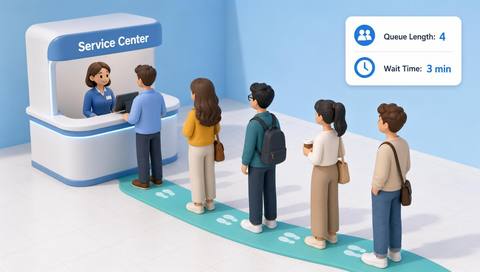
Distinguish service waiting from other clusters.
Read More
 People Counting
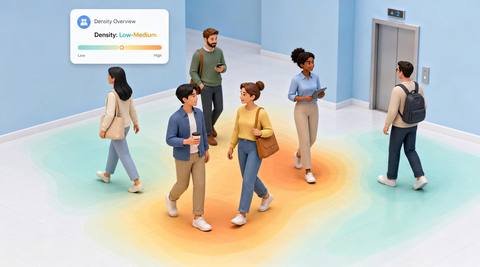
Assess concentration within the available space.
Read More People Counting
Review the same observable formation for a defined operational event.
Read MoreEXPLORE WHAT’S POSSIBLE
01 / 04 · GATHERING / GROUPING DETECTION
Grouped arrivals exceed desk capacity.
Example event: A persistent cluster forms.
Operator response: Coordinate check-in assistance.
Practical value: Supports arrival organization.
Discuss this capability02 / 04 · GATHERING / GROUPING DETECTION
Meeting attendees gather before opening.
Example event: A cluster appears near the room.
Operator response: Confirm the schedule and guide access.
Practical value: Improves circulation.
Discuss this capability03 / 04 · GATHERING / GROUPING DETECTION
Unstructured waiting looks like a gathering.
Example event: People remain around the counter.
Operator response: Organize the collection queue.
Practical value: Clarifies service demand.
Discuss this capability04 / 04 · GATHERING / GROUPING DETECTION
Include the surrounding route.
Visibility: Overlapping bodies limit group estimates.
Configuration: Validate grouping rules and time windows.
Privacy: Do not infer affiliation from proximity.
Human review: Check bookings and service context.
Discuss this capabilityFrequently asked questions
Identifies a cluster of people remaining together within a defined counting area.
No. Proximity does not prove shared membership.
This page focuses on aggregate demand and space planning rather than a security review.
They may unless persistence criteria are validated.
No. Available space and approved limits matter.
Find your fit
Explain local occupancy changes caused by group arrivals or waiting. For Service planners, Venue coordinators.
Workflow to discuss
Gathering / Grouping Detection + Explain clustered demand.
Discuss a camera view, a monitoring question and the review process your team needs.