Download IVISION Catalog

 01
Camera input
Show fork position and enough route to assess motion.


Assess the forks and vehicle motion together. Validate what constitutes the selected travel position and distinguish legitimate lifting or load placement from travel through the monitored area.
Catalog workflow. Detector availability, scene suitability and event delivery must be verified for the proposed deployment. Camera observations supplement human review and established safety procedures.
Discuss this workflow
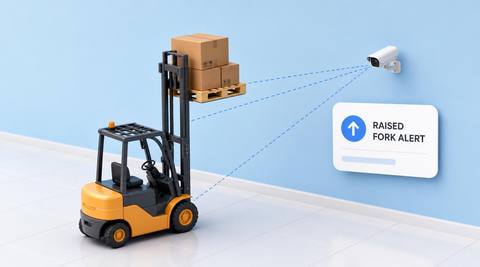
 Without IVISIONStandard CCTV feed
 With IVISIONIllustrative event overlay
The Process
Lifting at a rack is different from moving along a route Make raised-fork findings relevant to the maneuver.
01Show fork position and enough route to assess motion.
 02
Validate raised-position travel against stationary lifting tasks.
 03
Review the sequence and load-placement context.
 04
Supervisor confirms the maneuver and applicable operating procedure.
Explore Your Options
| Dimension |  Raised-Fork Safety Monitoring |  Forklift Maximum-Height Monitoring |
|---|---|---|
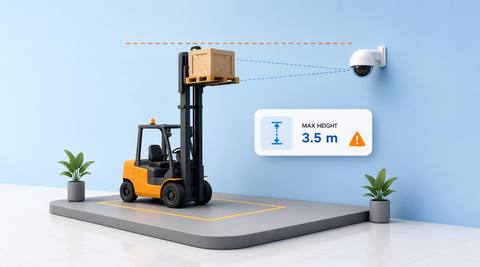
| Observation |  A moving forklift has visible forks above the assessed reference. | The selected mast, fork or load point crosses an assessed height reference. |
| Event criteria | Validated motion and fork-position criteria coincide. | A validated reference or measurement criterion is met. |
| Monitoring setup | Confirm travel area, reference and lifting-task exceptions. | Confirm the measured feature, calibration and clearance context. |
| What it cannot establish | Video cannot establish load stability, rated capacity or exact height without calibration. | The image alone cannot establish load stability or structural clearance. |
| Practical outcome | Help supervisors investigate fork-position context during movement. | Help supervisors investigate possible clearance exceedances without assuming an uncalibrated image gives exact height. |
Illustrative demonstration
Example footage and simulated events explain the review workflow. They do not measure detector performance.
 Sites overview
No matching events.
EXPLORE WHAT’S POSSIBLE
01 / 04 · RAISED-FORK SAFETY MONITORING
Forks may remain raised after leaving a rack.
Example event: Movement and raised-position indications coincide.
Operator response: Lead reviews the departure sequence.
Practical value: Specific coaching context.
Discuss this capability02 / 04 · RAISED-FORK SAFETY MONITORING
Loads obscure fork tips.
Example event: Fork position is uncertain during travel.
Operator response: Supervisor checks the available view.
Practical value: Avoids unsupported conclusions.
Discuss this capability03 / 04 · RAISED-FORK SAFETY MONITORING
Lifting and travel occur close together.
Example event: A truck moves with an apparent raised position.
Operator response: Team checks the maneuver stage.
Practical value: More contextual review.
Discuss this capability04 / 04 · RAISED-FORK SAFETY MONITORING
Use a side or oblique view of forks and floor.
Visibility: Loads and pallets can hide the forks.
Configuration: Validate motion, reference height and truck types.
Privacy: Limit identifiable operator data to justified review.
Human review: Confirm the maneuver and physical fork position.
Discuss this capabilityFrequently asked questions
Reviews visible forklift travel while the forks appear above an assessed travel-position reference.
No. Lifting and placement may require it; context matters.
Do not assume position when the relevant features are obscured.
Only with a separately validated measurement method.
It distinguishes stationary lifting from travel.
Find your fit
Help supervisors investigate fork-position context during movement. For Warehouse supervisors, Forklift training leads.
Workflow to discuss
Raised-Fork Safety Monitoring + Combine position with movement context.
Discuss a camera view, a monitoring question and the review process your team needs.