Download IVISION Catalog

 01
Camera input
Capture the access point from a safe, approved camera position.


Review a permitted view of the access point and any visible occupants. Entry authorization, isolation, atmosphere testing, communication and rescue readiness remain part of the approved confined-space procedure.
Catalog workflow. Detector availability, scene suitability and event delivery must be verified for the proposed deployment. Camera observations supplement human review and established safety procedures.
Discuss this workflow
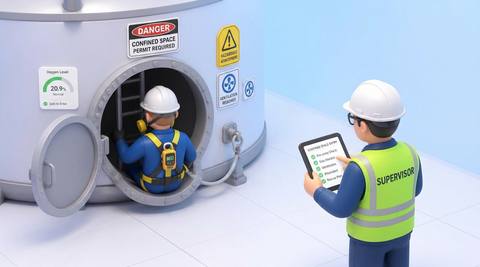
 Without IVISIONStandard CCTV feed
 With IVISIONIllustrative event overlay
The Process
A camera cannot assess a confined-space atmosphere Keep entry observations connected to the responsible attendant.
01Capture the access point from a safe, approved camera position.
 02
Validate visible entry or occupancy indications for that space.
 03
Review the event against the entry log and attendant’s account.
 04
The responsible team follows the entry and rescue procedure, not a camera-only decision.
Explore Your Options
| Dimension |  Confined-Space Safety Monitoring |  Hazardous-Area Entry Monitoring |
|---|---|---|
| Observation |  A person crosses or occupies the assessed access region. | A person crosses into the designated region. |
| Event criteria | Entry or continued presence meets the agreed visual criteria. | A validated entry criterion occurs in the relevant work period. |
| Monitoring setup | Validate access boundary, work period and camera coverage with the entry team. | Confirm boundary, schedule and authorized exceptions. |
| What it cannot establish | Video cannot measure oxygen, toxic gas or hidden occupants. | Entry alone does not establish permission, exposure or actual injury. |
| Practical outcome | Give the responsible attendant additional visual context without replacing entry control or atmospheric monitoring. | Give the responsible area owner a concrete entry event to verify. |
Illustrative demonstration
Example footage and simulated events explain the review workflow. They do not measure detector performance.
 Sites overview
No matching events.
EXPLORE WHAT’S POSSIBLE
01 / 04 · CONFINED-SPACE SAFETY MONITORING
The attendant needs context around the opening.
Example event: A person crosses the access boundary.
Operator response: Attendant reconciles the observation with the entry log.
Practical value: Additional entry evidence.
Discuss this capability02 / 04 · CONFINED-SPACE SAFETY MONITORING
Maintenance crews change during a job.
Example event: A new person approaches or enters.
Operator response: Supervisor checks the permit and handover.
Practical value: Clearer crew coordination.
Discuss this capability03 / 04 · CONFINED-SPACE SAFETY MONITORING
Internal visibility is limited.
Example event: A visible occupant remains in the assessed view.
Operator response: Attendant verifies communication and status.
Practical value: Focused visual support.
Discuss this capability04 / 04 · CONFINED-SPACE SAFETY MONITORING
Use equipment and positioning approved for the environment.
Visibility: Darkness, openings and obstructions limit occupancy visibility.
Configuration: Confirm hazardous-area equipment suitability and detector coverage.
Privacy: Limit monitoring to the authorized entry purpose.
Human review: Atmosphere, permit, isolation and rescue readiness need separate verification.
Discuss this capabilityFrequently asked questions
Supports visual review of people at a defined confined-space access point or observable interior area.
No. Ordinary video does not measure a safe atmosphere.
Not if there are blind spots; follow the approved headcount and entry process.
Follow the established rescue plan and trained response procedure.
No. Equipment suitability and installation conditions require specialist assessment.
Find your fit
Give the responsible attendant additional visual context without replacing entry control or atmospheric monitoring. For Confined-space entry supervisors, Maintenance coordinators.
Workflow to discuss
Confined-Space Safety Monitoring + Supplement entry logs with visible context.
Discuss a camera view, a monitoring question and the review process your team needs.