Download IVISION Catalog

 01
Prepare the view
Cover the queue start, progression and service point.


A long queue does not always mean a long wait. Validate queue boundaries, entry/exit events and tracking continuity before using length or duration estimates to assess staffing and service arrangements.
Catalog workflow. Confirm detector availability, permitted use and event delivery for the proposed deployment. Website examples are illustrative.
Assess queue measurement
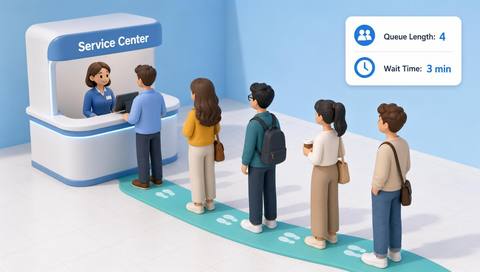
 Without IVISIONStandard CCTV feed
 With IVISIONIllustrative event overlay
The Process
Separate queue length from elapsed waiting time Compare demand with the actual waiting process.
01Cover the queue start, progression and service point.
 02
Validate counting and duration against representative samples.
 03
Review length and waiting estimates separately.
 04
Check the service cause before opening capacity or changing layout.
Explore Your Options
| Dimension |  Queue Length & Wait Time Estimation |  Dwell Time Analysis |
|---|---|---|
| Observation |  People occupying a defined waiting route. | A person track remains within a defined area. |
| Event criteria | Supported analysis counts the queue or links waiting-entry and service-exit observations. | Supported tracking links zone entry and exit or a qualified ongoing stay. |
| Monitoring setup | Confirm queue geometry, abandonment and service-point definitions. | Confirm boundary, track-gap policy and repeat visits. |
| What it cannot establish | Cannot infer customer satisfaction or measure unseen waiting accurately. | Cannot establish interest, satisfaction or continuous presence during gaps. |
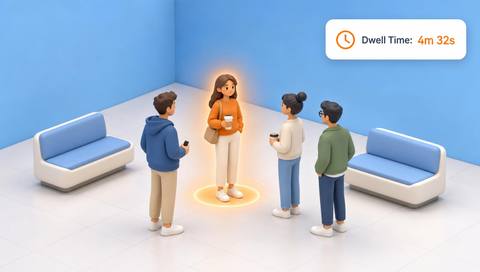
| Practical outcome | Help service teams assess bottlenecks with measurable queue context. | Help teams distinguish brief passages from longer stays. |
Illustrative demonstration
Example footage and simulated events explain the review workflow. They do not measure detector performance.
 Sites overview
No matching events.
EXPLORE WHAT’S POSSIBLE
01 / 04 · QUEUE LENGTH & WAIT TIME ESTIMATION
Queues shift between tills.
Example event: One lane’s estimated wait rises.
Operator response: Review staffing and lane availability.
Practical value: Supports service balancing.
Discuss this capability02 / 04 · QUEUE LENGTH & WAIT TIME ESTIMATION
Appointments create arrival bursts.
Example event: A queue grows before service begins.
Operator response: Check scheduling and reception resources.
Practical value: Explains peak demand.
Discuss this capability03 / 04 · QUEUE LENGTH & WAIT TIME ESTIMATION
People abandon or switch queues.
Example event: Track continuity changes duration estimates.
Operator response: Review abandonment handling.
Practical value: Improves metric interpretation.
Discuss this capability04 / 04 · QUEUE LENGTH & WAIT TIME ESTIMATION
See queue endpoints and service boundary.
Visibility: Crossing traffic and crowding break tracks.
Configuration: Verify duration method, abandonment and sampling.
Privacy: Use aggregate waiting metrics without demographic inference.
Human review: Check service operations before attributing causes.
Discuss this capabilityFrequently asked questions
Estimates people waiting in a defined queue and, where tracking supports it, the time spent waiting.
No. Service rate affects waiting time.
Yes. Abandonment and switching need validated handling.
No. Waiting is observable; satisfaction requires appropriate feedback.
No. Duration requires a supported sequence or other validated method.
Find your fit
Help service teams assess bottlenecks with measurable queue context. For Retail operations leads, Service-desk managers.
Workflow to discuss
Queue Length & Wait Time Estimation + Separate length and duration.
Discuss a camera view, a monitoring question and the review process your team needs.