Download IVISION Catalog

 01
Camera input
Frame the release point and surrounding containment.


Assess visible pooling, dripping or discharge at a known process point. Use the equipment context and appropriate instruments to establish the material and response; do not infer toxicity from color or shape.
Catalog workflow. Detector availability, scene suitability and event delivery must be verified for the proposed deployment. Camera observations supplement human review and established safety procedures.
Discuss this workflow
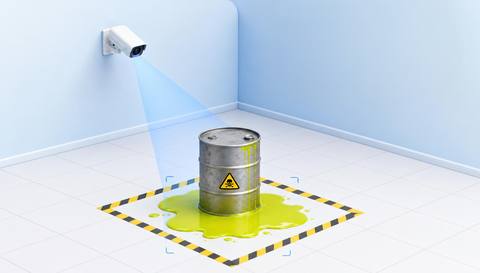
 Without IVISIONStandard CCTV feed
 With IVISIONIllustrative event overlay
The Process
The image cannot identify the substance Connect a release indication with the correct process location.
01Frame the release point and surrounding containment.
 02
Validate visible release examples against normal operations.
 03
Review the apparent origin and relevant process context.
 04
Qualified staff follows the substance-specific response procedure.
Explore Your Options
| Dimension |  Visible Hazardous-Material Leaks |  Liquid-Spill Detection |
|---|---|---|
| Observation |  Visible material appears outside its expected containment. | A visible pool or spill-like surface change. |
| Event criteria | A validated release or pooling criterion is met. | A validated liquid-region criterion appears in the assessed area. |
| Monitoring setup | Confirm containment boundary, normal discharge and cleaning exceptions. | Confirm floor region, cleaning periods and normal reflections. |
| What it cannot establish | Video cannot establish chemical identity, concentration or exposure. | Video does not establish liquid type, depth or slip resistance. |
| Practical outcome | Help operators locate a possible release without inferring its chemistry from appearance. | Help facilities locate a possible spill and assign a physical check. |
Illustrative demonstration
Example footage and simulated events explain the review workflow. They do not measure detector performance.
 Sites overview
No matching events.
EXPLORE WHAT’S POSSIBLE
01 / 04 · VISIBLE HAZARDOUS-MATERIAL LEAKS
Small releases may be hard to locate remotely.
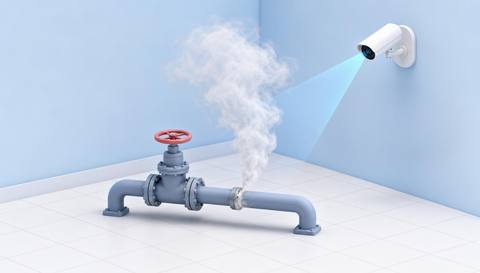
Example event: Material appears outside the connection area.
Operator response: Operator checks process records and response requirements.
Practical value: Location-specific assessment.
Discuss this capability02 / 04 · VISIBLE HAZARDOUS-MATERIAL LEAKS
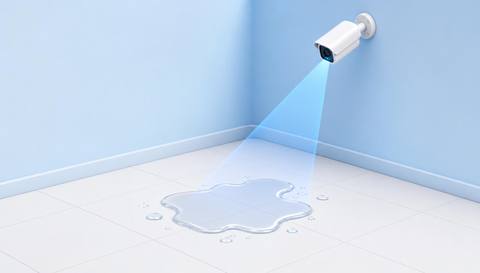
Cleaning water resembles a process leak.
Example event: Pooling appears near equipment.
Operator response: Team verifies source without assuming chemistry.
Practical value: More careful classification.
Discuss this capability03 / 04 · VISIBLE HAZARDOUS-MATERIAL LEAKS
A release may spread beyond one container.
Example event: Liquid appears outside the storage footprint.
Operator response: Responsible staff applies the site procedure.
Practical value: Focused containment review.
Discuss this capability04 / 04 · VISIBLE HAZARDOUS-MATERIAL LEAKS
Show equipment base and containment boundary.
Visibility: Clear liquids and concealed pipes may be invisible.
Configuration: Validate the specific release appearance and environment.
Privacy: Avoid unnecessary worker identification in process footage.
Human review: Confirm substance, exposure and safe response through proper procedures.
Discuss this capabilityFrequently asked questions
Reviews visible material release near an assessed vessel, pipe or storage point.
No. Appearance alone does not establish composition.
No. Appropriate sensors or inspection are required.
Follow the site’s safe assessment and response procedure.
Yes. Validate normal cleaning and discharge conditions.
Find your fit
Help operators locate a possible release without inferring its chemistry from appearance. For Process safety operators, Environmental response coordinators.
Workflow to discuss
Visible Hazardous-Material Leaks + Locate the apparent release point.
Discuss a camera view, a monitoring question and the review process your team needs.