Download IVISION Catalog

 01
Prepare the view
Frame the walkway and adjacent traffic area.


A marked route works only if it is visible, accessible and practical. Evaluate observed pedestrian paths against the current layout, then inspect obstructions or task needs before treating a deviation as a rule breach.
Catalog workflow. Confirm detector availability, permitted use and event delivery for the proposed deployment. Website examples are illustrative.
Review pedestrian routes
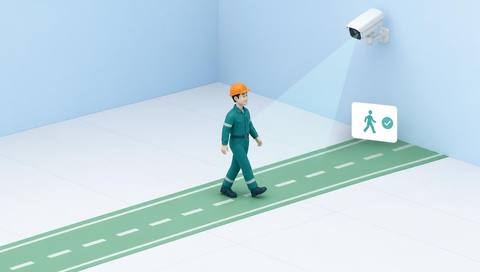
 Without IVISIONStandard CCTV feed
 With IVISIONIllustrative event overlay
The Process
Review departures from the intended walkway Find reasons people leave the designated path.
01Frame the walkway and adjacent traffic area.
 02
Validate person tracks against the current route boundaries.
 03
Review boundary-crossing candidates with route conditions.
 04
Inspect obstructions and adjust guidance or layout through the safety process.
Explore Your Options
| Dimension |  Pedestrian-pathway monitoring |  Pedestrian entry, vehicle-only areas |
|---|---|---|
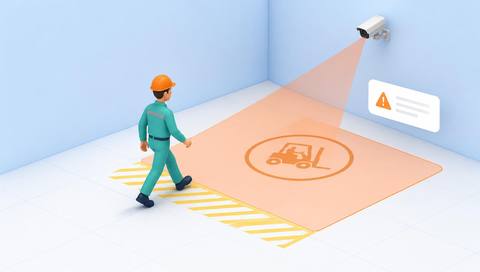
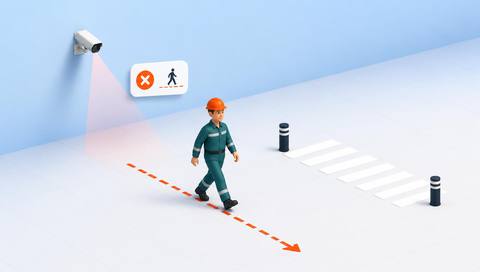
| Observation |  People moving inside or outside a defined walkway. | A person crosses into a vehicle-exclusive boundary. |
| Event criteria | A supported track crosses the agreed route boundary. | A supported person track enters the defined zone during its active period. |
| Monitoring setup | Confirm walkway geometry, permitted crossings and temporary diversions. | Confirm boundaries, authorized tasks and temporary access. |
| What it cannot establish | Cannot establish why someone departed or whether a deviation was authorized. | Cannot establish unauthorized status or safe separation by entry alone. |
| Practical outcome | Help teams review where route layout and actual movement diverge. | Help teams review separation of people and industrial traffic. |
Illustrative demonstration
Example footage and simulated events explain the review workflow. They do not measure detector performance.
 Sites overview
No matching events.
EXPLORE WHAT’S POSSIBLE
01 / 04 · PEDESTRIAN-PATHWAY MONITORING
A pallet blocks the walkway.
Example event: People repeatedly step outside the line.
Operator response: Remove the obstruction and review storage.
Practical value: Explains recurring deviations.
Discuss this capability02 / 04 · PEDESTRIAN-PATHWAY MONITORING
A maintenance diversion changes the route.
Example event: Movement crosses the old boundary.
Operator response: Update the approved temporary route.
Practical value: Keeps monitoring aligned.
Discuss this capability03 / 04 · PEDESTRIAN-PATHWAY MONITORING
The crossing point is inconvenient.
Example event: Pedestrians take a shortcut.
Operator response: Review the route with traffic management.
Practical value: Informs practical layout changes.
Discuss this capability04 / 04 · PEDESTRIAN-PATHWAY MONITORING
Show route markings and adjacent ground.
Visibility: Faded lines and occlusion reduce interpretation.
Configuration: Verify track model and boundary calibration.
Privacy: Use route-level patterns without unnecessary identities.
Human review: Check physical conditions before assigning blame.
Discuss this capabilityFrequently asked questions
Observes pedestrian movement relative to designated walking routes.
No. Diversions and task exceptions require context.
Revalidate boundaries after any layout change.
No. Route-use review can focus on anonymous tracks.
Address the obstruction rather than only recording departures.
Find your fit
Help teams review where route layout and actual movement diverge. For Safety coordinators, Facility planners.
Workflow to discuss
Pedestrian-pathway monitoring + Compare planned and actual routes.
Discuss a camera view, a monitoring question and the review process your team needs.