Download IVISION Catalog

 01
Prepare the view
Assess whether face and eyes are sufficiently visible.


Head position or repeated eye closure may have several explanations. Any assessment needs a purpose-built view and validated model; a routine wide-angle CCTV feed should not be assumed capable of determining fatigue.
Catalog workflow. Confirm detector availability, permitted use and event delivery for the proposed deployment. Website examples are illustrative.
Assess fatigue-cue suitability
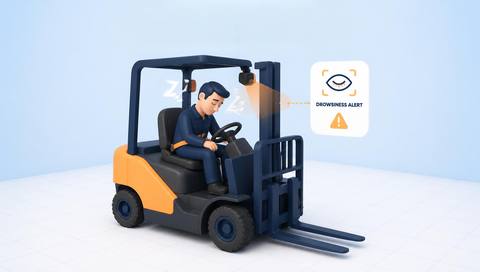
 Without IVISIONStandard CCTV feed
 With IVISIONIllustrative event overlay
The Process
A camera cannot certify alertness Support a defined check-in process without diagnosis.
01Assess whether face and eyes are sufficiently visible.
 02
Validate supported cues with realistic lighting and eyewear.
 03
Review the sequence and task context through the approved process.
 04
Follow the established operator welfare and fitness-for-task procedure.
Explore Your Options
| Dimension |  Driver and personnel drowsiness |  Sleeping / Inactivity Detection |
|---|---|---|
| Observation |  Observable head or eye cues in a suitable view. | Low visible motion or a sustained posture. |
| Event criteria | A validated model identifies the agreed temporal cue pattern. | A supported analysis observes inactivity beyond the agreed task-specific period. |
| Monitoring setup | Confirm view, cue duration, exemptions and response protocol. | Validate duration, scheduled breaks and stationary-task exceptions. |
| What it cannot establish | Cannot diagnose fatigue, health status or fitness to drive. | Cannot prove sleep, fatigue, neglect or medical condition. |
| Practical outcome | Clarify when a cue should prompt a human fitness-for-task check. | Help supervisors distinguish an unexpected stationary period from normal work. |
Illustrative demonstration
Example footage and simulated events explain the review workflow. They do not measure detector performance.
 Sites overview
No matching events.
 People Events
Separate low movement from fatigue-related cues.
Read More
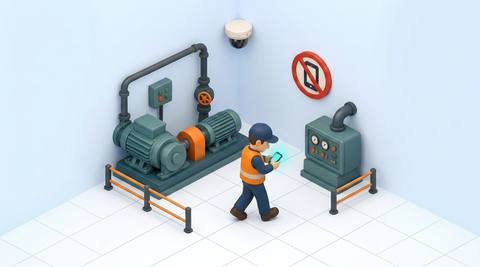 People Events
Review another observable operator behavior independently.
Read More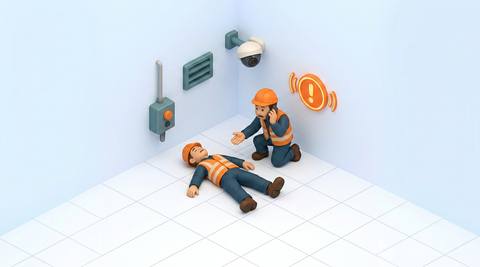 People Events
Use welfare checks for unusual posture without diagnosis.
Read MoreEXPLORE WHAT’S POSSIBLE
01 / 04 · DRIVER AND PERSONNEL DROWSINESS
Glasses obscure eye cues.
Example event: Repeated eye-closure candidates appear.
Operator response: Check the operator through the approved protocol.
Practical value: Provides a defined review prompt.
Discuss this capability02 / 04 · DRIVER AND PERSONNEL DROWSINESS
Head movement can resemble nodding.
Example event: A repeated head cue is flagged.
Operator response: Verify the task and welfare.
Practical value: Avoids posture-only diagnosis.
Discuss this capability03 / 04 · DRIVER AND PERSONNEL DROWSINESS
The proposed camera may be unsuitable.
Example event: Cue labels fail under night lighting.
Operator response: Reject or improve the setup before deployment.
Practical value: Prevents unsupported reliance.
Discuss this capability04 / 04 · DRIVER AND PERSONNEL DROWSINESS
Use a purpose-designed permitted operator view.
Visibility: Eyewear, glare and head angle affect detail.
Configuration: No specific drowsiness model or performance was verified.
Privacy: Treat employee health-related observations with strict access limits.
Human review: Use qualified procedures rather than an AI fitness decision.
Discuss this capabilityFrequently asked questions
A catalog workflow for reviewing visible fatigue-related cues where suitable close-view analysis is validated.
No. A suitable view and validated cue analysis are prerequisites, and outputs remain uncertain.
Yes. Eye detail may be unavailable.
No. Follow the established fitness-for-task procedure.
Yes. Task actions and camera angle can produce similar cues.
Find your fit
Clarify when a cue should prompt a human fitness-for-task check. For Fleet safety leads, Occupational safety teams.
Workflow to discuss
Driver and personnel drowsiness + Assess view suitability first.
Discuss a camera view, a monitoring question and the review process your team needs.