Download IVISION Catalog

 01
Prepare the view
Assess the ground plane and full approach paths.


Apparent convergence in a camera view is not proof that a collision will occur. Evaluate tracking, calibration and uncertainty before considering conflict estimates, and keep established segregation and traffic controls in place.
Catalog workflow. Confirm detector availability, permitted use and event delivery for the proposed deployment. Website examples are illustrative.
Review conflict-estimation scope
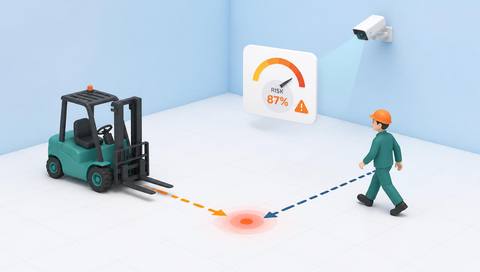
 Without IVISIONStandard CCTV feed
 With IVISIONIllustrative event overlay
The Process
Prediction requires validated geometry and timing Understand the limits of trajectory-based warnings.
01Assess the ground plane and full approach paths.
 02
Validate tracking and any time-to-conflict calculation.
 03
Review the proposed conflict with visibility gaps and barriers.
 04
Use confirmed patterns to inform traffic management, not automatic vehicle control.
Explore Your Options
| Dimension |  Collision-risk estimation |  Vehicle-person near-miss detection |
|---|---|---|
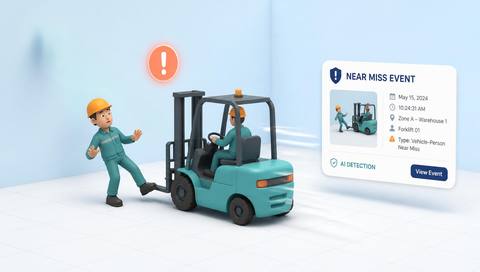
| Observation |  Vehicle and pedestrian paths appear to converge. | Close person/vehicle paths with a possible evasive or conflict pattern. |
| Event criteria | A validated model meets an agreed spatial and temporal conflict criterion. | A supported temporal analysis meets validated interaction criteria. |
| Monitoring setup | Confirm calibration, motion assumptions and event thresholds. | Confirm trajectory thresholds, timing and event boundaries. |
| What it cannot establish | Cannot guarantee prediction, warning lead time or collision prevention. | Cannot prove fault, inevitable collision or injury avoidance. |
| Practical outcome | Clarify which interactions deserve closer review without promising prediction. | Help safety teams examine the sequence around a narrowly avoided conflict. |
Illustrative demonstration
Example footage and simulated events explain the review workflow. They do not measure detector performance.
 Sites overview
No matching events.
EXPLORE WHAT’S POSSIBLE
01 / 04 · COLLISION-RISK ESTIMATION
Apparent convergence depends on perspective.
Example event: Paths overlap in the image.
Operator response: Check calibrated positions and timing.
Practical value: Avoids geometry-driven false conclusions.
Discuss this capability02 / 04 · COLLISION-RISK ESTIMATION
Vehicle direction changes during maneuvers.
Example event: A forecast path approaches a pedestrian.
Operator response: Review the full maneuver.
Practical value: Tests motion assumptions.
Discuss this capability03 / 04 · COLLISION-RISK ESTIMATION
A barrier separates flows.
Example event: Image paths appear to intersect.
Operator response: Verify physical separation.
Practical value: Checks whether a conflict is plausible.
Discuss this capability04 / 04 · COLLISION-RISK ESTIMATION
Include enough ground plane for calibration.
Visibility: Track loss makes forecasts unreliable.
Configuration: No deployed conflict model or lead-time benchmark was verified.
Privacy: Analyze traffic interactions with minimal identity data.
Human review: Require engineering review of predicted risk.
Discuss this capabilityFrequently asked questions
A catalog workflow for evaluating potential path conflicts from visible vehicle and pedestrian motion.
No. Prediction quality and lead time have not been verified.
Yes. Perspective, elevation or barriers can explain overlap.
No. One reviews an observed sequence; the other estimates a possible future conflict.
No. Keep approved physical and operational controls.
Find your fit
Clarify which interactions deserve closer review without promising prediction. For Traffic safety engineers, Operations investigators.
Workflow to discuss
Collision-risk estimation + Expose trajectory assumptions.
Discuss a camera view, a monitoring question and the review process your team needs.