Download IVISION Catalog

 01
Camera input
Capture the approach paths and enough surrounding space for context.


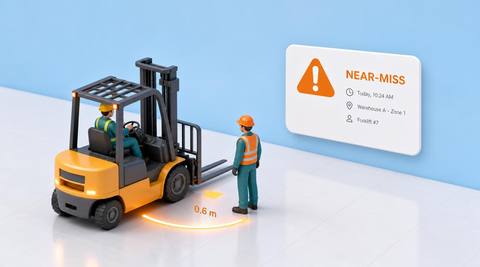
A short separation in one frame is not enough to establish a near miss. Review the movement sequence, site layout and actual operating context to determine whether a meaningful close interaction occurred.
Catalog workflow. Detector availability, scene suitability and event delivery must be verified for the proposed deployment. Camera observations supplement human review and established safety procedures.
Discuss this workflow
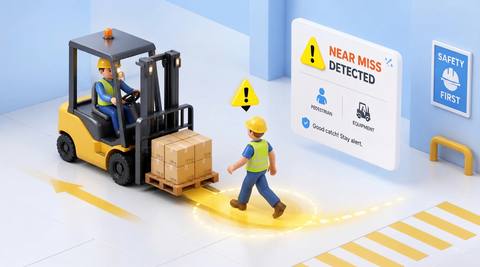
 Without IVISIONStandard CCTV feed
 With IVISIONIllustrative event overlay
The Process
Position, movement and timing all matter Build a review queue for pedestrian–equipment interactions.
01Capture the approach paths and enough surrounding space for context.
 02
Validate person/equipment tracking and any separation calculation.
 03
Review the sequence before and after the indicated interaction.
 04
Safety staff interviews relevant people and records the assessed circumstances.
Explore Your Options
| Dimension |  People–Equipment Near Miss |  Forklift Near-Miss |
|---|---|---|
| Observation |  A person and equipment approach closely under the assessed criteria. | A forklift approaches another person or vehicle under assessed criteria. |
| Event criteria | Validated position and movement indications meet the candidate-event rule. | Validated movement and separation indications create a candidate event. |
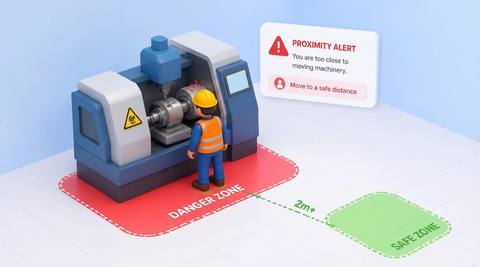
| Monitoring setup | Agree geometry, time context and equipment classes to assess. | Confirm interaction types, geometry and review windows. |
| What it cannot establish | Video alone may not establish distance, intent, braking or causation. | Apparent proximity does not establish collision risk, blame or exact distance. |
| Practical outcome | Help safety teams investigate interaction patterns without declaring a collision or near miss from proximity alone. | Help safety teams review convergence, separation and operating context without automatically declaring a near miss. |
Illustrative demonstration
Example footage and simulated events explain the review workflow. They do not measure detector performance.
 Sites overview
No matching events.
EXPLORE WHAT’S POSSIBLE
01 / 04 · PEOPLE–EQUIPMENT NEAR MISS
Shelving conceals approaching traffic.
Example event: A pedestrian and powered truck converge.
Operator response: Supervisor reviews the full approach.
Practical value: Evidence for intersection improvements.
Discuss this capability02 / 04 · PEOPLE–EQUIPMENT NEAR MISS
Workers and mobile plant share a temporary route.
Example event: A close interaction is indicated.
Operator response: Site lead checks spotter and route arrangements.
Practical value: Context for traffic-plan review.
Discuss this capability03 / 04 · PEOPLE–EQUIPMENT NEAR MISS
Equipment moves between workstations.
Example event: A person passes close to moving equipment.
Operator response: Safety team checks task coordination.
Practical value: More specific briefings.
Discuss this capability04 / 04 · PEOPLE–EQUIPMENT NEAR MISS
Show both approach paths and the interaction area.
Visibility: Occlusion can break tracks and exaggerate closeness.
Configuration: Validate geometry, tracking and event criteria against real site examples.
Privacy: Restrict investigation access and avoid automated worker ranking.
Human review: A qualified reviewer determines whether a near miss occurred.
Discuss this capabilityFrequently asked questions
Identifies candidate close interactions between people and moving equipment for contextual review.
No. Context, actual separation and exposure must be reviewed.
No. Video indications do not establish causation or responsibility.
Only with a verified calibration or measurement method.
It helps distinguish planned coordination from unexpected convergence.
Find your fit
Help safety teams investigate interaction patterns without declaring a collision or near miss from proximity alone. For Safety investigators, Operations supervisors.
Workflow to discuss
People–Equipment Near Miss + Review sequences rather than isolated close frames.
Discuss a camera view, a monitoring question and the review process your team needs.