Download IVISION Catalog

 01
Camera input
Capture the features needed for the chosen distinction.


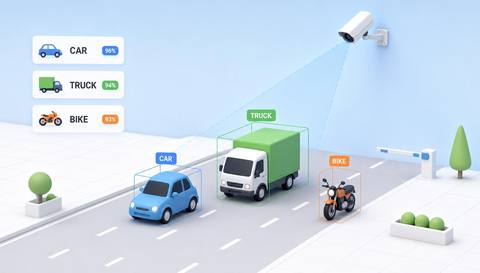
A site may need to distinguish a rigid truck from an articulated vehicle or one supported subtype from another. Define the taxonomy and test the view; do not assume exact make, model or year recognition.
Catalog workflow. Detector availability, scene suitability and event delivery must be verified for the proposed deployment. Camera observations supplement human review and established safety procedures.
Discuss this workflow
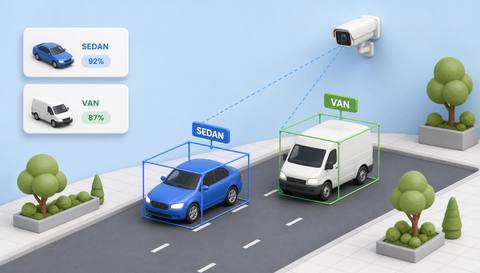
 Without IVISIONStandard CCTV feed
 With IVISIONIllustrative event overlay
The Process
Specific labels require specific evidence Avoid promising detail the camera cannot establish.
01Capture the features needed for the chosen distinction.
 02
Validate the specific types and lookalike vehicles.
 03
Review uncertain labels with the source image.
 04
Operator uses the label only within its verified scope.
Explore Your Options
| Dimension |  Vehicle-Type Identification |  Vehicle Classification |
|---|---|---|
| Observation |  Visible body features match a validated type label. | Visible vehicle features match a supported broad class. |
| Event criteria | The supported type criterion is met with adequate detail. | A validated category indication is available for a detected vehicle. |
| Monitoring setup | Confirm the exact taxonomy, unknown handling and view requirements. | Define category boundaries and ambiguous-case handling. |
| What it cannot establish | Exact model, year and mechanical specification are not established without separate evidence. | Appearance cannot establish payload, legal vehicle class or exact specification. |
| Practical outcome | Help teams evaluate whether a required vehicle distinction is visually supportable. | Help teams review traffic mix without claiming exact make or model recognition. |
Illustrative demonstration
Example footage and simulated events explain the review workflow. They do not measure detector performance.
 Sites overview
No matching events.
EXPLORE WHAT’S POSSIBLE
01 / 04 · VEHICLE-TYPE IDENTIFICATION
Different truck configurations need different bays.
Example event: A supported body configuration is indicated.
Operator response: Dispatcher verifies the bay requirement.
Practical value: More useful arrival context.
Discuss this capability02 / 04 · VEHICLE-TYPE IDENTIFICATION
Specialist vehicles differ from ordinary vans.
Example event: A candidate subtype appears.
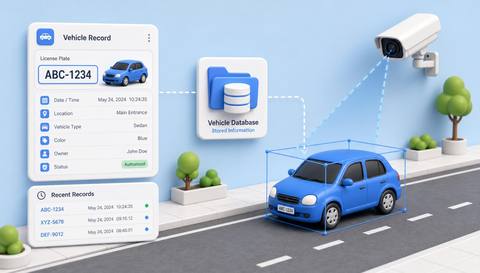
Operator response: Fleet staff confirms the vehicle record.
Practical value: Focused record matching.
Discuss this capability03 / 04 · VEHICLE-TYPE IDENTIFICATION
Similar vehicles have operationally important differences.
Example event: Type recognition is uncertain.
Operator response: Inspector checks the vehicle directly.
Practical value: Avoids overconfident assignment.
Discuss this capability04 / 04 · VEHICLE-TYPE IDENTIFICATION
Use a view showing distinguishing body features.
Visibility: Attachments, branding and partial views mislead labels.
Configuration: Verify taxonomy and evaluation for each requested type.
Privacy: Limit record linkage to authorized fleet purposes.
Human review: Confirm consequential type assignments using records or inspection.
Discuss this capabilityFrequently asked questions
Assesses more specific supported vehicle appearance labels beyond a broad vehicle category.
No. That requires a separately verified model inventory and evaluation.
It considers a more specific supported distinction than broad car/van/truck labels.
No. Branding alone is insufficient.
Keep the result uncertain and use another source of evidence.
Find your fit
Help teams evaluate whether a required vehicle distinction is visually supportable. For Fleet operations teams, Specialist access managers.
Workflow to discuss
Vehicle-Type Identification + Define the required level of detail.
Discuss a camera view, a monitoring question and the review process your team needs.