Download IVISION Catalog

 01
Prepare the view
Document the relevant action and monitored area.


Choose measurable conditions such as repeated boundary approaches or out-of-hours presence. Avoid treating appearance, identity or unfamiliar behavior as evidence of wrongdoing, and require contextual review of every candidate.
Catalog workflow. Confirm detector availability, permitted use and event delivery for the proposed deployment. Website examples are illustrative.
Define observable security criteria
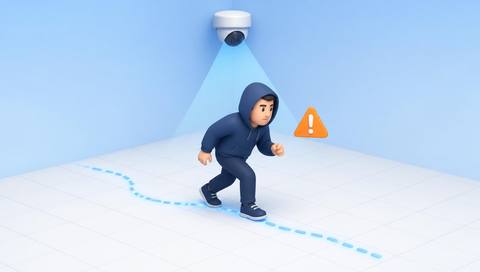
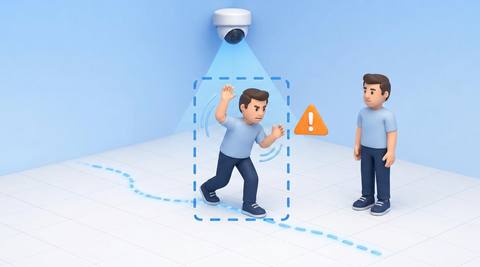
 Without IVISIONStandard CCTV feed
 With IVISIONIllustrative event overlay
The Process
An observation cannot establish intent Make security review criteria specific and accountable.
01Document the relevant action and monitored area.
 02
Validate supported criteria against ordinary legitimate behavior.
 03
Show what was observed rather than an unexplained suspicion score.
 04
Verify the context and use proportionate authorized procedures.
Explore Your Options
| Dimension |  Suspicious Behavior Detection |  Loitering Detection |
|---|---|---|
| Observation |  An agreed action, route or duration pattern. | A person stays within a monitored boundary. |
| Event criteria | A supported rule finds the specified observable condition. | Supported tracking exceeds the validated duration threshold. |
| Monitoring setup | Document criteria, exceptions and review purpose. | Confirm boundary, timing, re-entry handling and waiting exceptions. |
| What it cannot establish | Cannot infer criminal intent, trustworthiness or threat from appearance. | Cannot establish intent, unauthorized status or continuous presence during track gaps. |
| Practical outcome | Replace vague suspicion with explainable observations. | Help operators review prolonged presence in context. |
Illustrative demonstration
Example footage and simulated events explain the review workflow. They do not measure detector performance.
 Sites overview
No matching events.
EXPLORE WHAT’S POSSIBLE
01 / 04 · SUSPICIOUS BEHAVIOR DETECTION
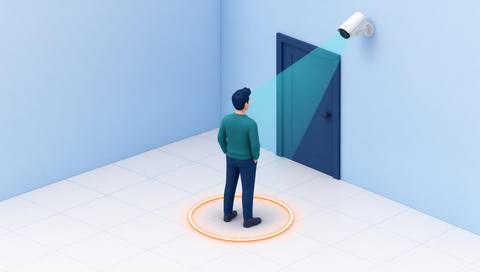
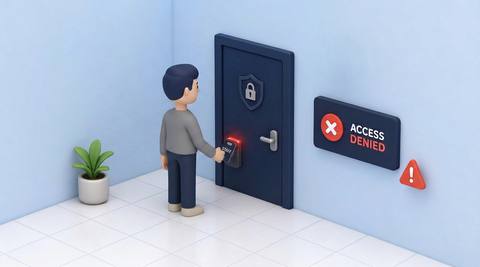
Repeated approaches need explanation.
Example event: A person returns to a locked door.
Operator response: Check whether they need access assistance.
Practical value: Supports proportionate follow-up.
Discuss this capability02 / 04 · SUSPICIOUS BEHAVIOR DETECTION
A visitor may be lost.
Example event: Repeated boundary approaches occur.
Operator response: Confirm destination and escort.
Practical value: Resolves context before escalation.
Discuss this capability03 / 04 · SUSPICIOUS BEHAVIOR DETECTION
Authorized contractors work unusual hours.
Example event: Presence falls outside the usual schedule.
Operator response: Check work authorization.
Practical value: Avoids assuming wrongdoing.
Discuss this capability04 / 04 · SUSPICIOUS BEHAVIOR DETECTION
Frame the relevant action and boundary.
Visibility: Partial views omit context.
Configuration: Verify rules instead of claiming generalized intent detection.
Privacy: Do not profile by protected or personal characteristics.
Human review: Establish facts through authorized contextual checks.
Discuss this capabilityFrequently asked questions
A legacy label for reviewing explicitly defined activity exceptions, not determining suspicious intent.
No. Camera appearance or movement cannot establish intent.
A clear description of the action, time and location requiring review.
Yes. Assistance needs, maintenance and changed routines are common explanations.
No. Use relevant observable criteria and proportionate procedures.
Find your fit
Replace vague suspicion with explainable observations. For Security managers, Governance reviewers.
Workflow to discuss
Suspicious Behavior Detection + Use explicit observable criteria.
Discuss a camera view, a monitoring question and the review process your team needs.