Download IVISION Catalog

 01
Assess an authorized view
Choose a position where relevant movement remains visible and define permitted observation hours.


A stationary person may be reading, waiting, resting or obscured. An inactivity workflow considers a defined observation interval and the quality of the camera view, then gives a responsible reviewer context for an appropriate check. It cannot diagnose a health condition or prove that someone is asleep.
Confirm detector availability, supported duration settings and event delivery for the proposed deployment.
Assess an inactivity workflow

 Without IVISIONStandard CCTV feed
 With IVISIONIllustrative event overlay
The Process
An interval without visible movement needs interpretation. Separate a missing movement observation from a conclusion about the person.
01Choose a position where relevant movement remains visible and define permitted observation hours.
 02
Use representative activity to separate expected quiet periods from an observation worth reviewing.
 03
If the workflow is supported, present the interval and available frames. Verify stream continuity before interpreting stillness.
 04
A reviewer checks context and requests proportionate assistance where appropriate. Test any notification route separately.
Explore Your Options
| Dimension |  Prolonged Inactivity Observation |  Sleeping / Inactivity Detection |
|---|---|---|
| Observation |  Little or no observable movement associated with a visible person or defined area over time. | Low visible motion or a sustained posture. |
| Event criteria | A supported analysis remains below an agreed movement criterion for the configured interval. | A supported analysis observes inactivity beyond the agreed task-specific period. |
| Monitoring setup | Select the zone, duration, operating hours and ordinary stillness exceptions; confirm which controls the deployment supports. | Validate duration, scheduled breaks and stationary-task exceptions. |
| What it cannot establish | Occlusion, a stalled stream and quiet work can resemble inactivity. Stillness does not establish unconsciousness, sleep or misconduct. | Cannot prove sleep, fatigue, neglect or medical condition. |
| Practical outcome | Adds a time-based observation to welfare or operational review without assuming sleep or illness. | Help supervisors distinguish an unexpected stationary period from normal work. |
Illustrative demonstration
Example footage and simulated events explain the review workflow. They do not measure detector performance.
 Sites overview
No matching events.
People EventsExplains the distinction between posture, apparent rest and missing movement.
Read More
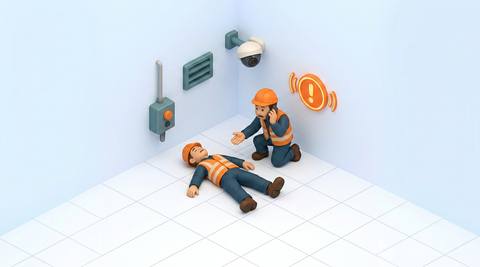 People Events
A person-down posture is a separate visible observation.
Read More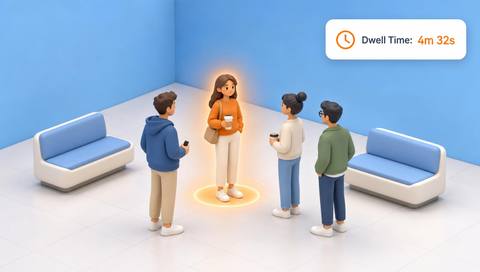 People Events
Time spent in a zone is distinct from the amount of movement within it.
Read MoreEXPLORE WHAT’S POSSIBLE
01 / 04 · PROLONGED INACTIVITY OBSERVATION
A person remains stationary after the normal visitor period.
Example event: An observed inactivity interval exceeds the agreed review duration.
Operator response: Reception staff check the scene and follow the welfare procedure.
Practical value: The review has a specific time and location.
Discuss this capability02 / 04 · PROLONGED INACTIVITY OBSERVATION
Normal inspection work includes long stationary periods.
Example event: A stillness flag occurs during an expected inspection interval.
Operator response: The supervisor reviews context and records it as an expected exception.
Practical value: Configuration can distinguish operational pauses from useful review cues.
Discuss this capability03 / 04 · PROLONGED INACTIVITY OBSERVATION
A fixed camera image might be mistaken for inactive occupants.
Example event: The scene appears unchanged across the observation window.
Operator response: The operator checks stream health before arranging a welfare check.
Practical value: A feed problem is not presented as a medical event.
Discuss this capability04 / 04 · PROLONGED INACTIVITY OBSERVATION
Keep the relevant body movement visible without monitoring inappropriate private areas.
Visibility: Distant subjects, occlusion and low frame continuity can invalidate an inactivity interval.
Configuration: Confirm a supported temporal model and how its events reach review; arbitrary duration controls are not assumed.
Privacy: Limit monitoring to an approved purpose and avoid individual productivity scoring.
Human review: A trained person must interpret the observation and follow established welfare procedures.
Discuss this capabilityFrequently asked questions
Reviews a visible person or area that remains without sufficient observable movement for a configured interval.
No. A person may be reading, waiting or doing stationary work.
Use normal site activity and the response purpose to agree a useful interval; then verify supported settings.
Yes. Verify timestamps and stream continuity before concluding that the scene is inactive.
No. It does not diagnose distress or replace clinical or emergency procedures.
Find your fit
Adds a time-based observation to welfare or operational review without assuming sleep or illness. For Facility operators, Welfare-response coordinators, Shift supervisors.
Workflow to discuss
Prolonged Inactivity Observation + Supplies an observation interval for a welfare check.
Discuss a camera view, a monitoring question and the review process your team needs.