Download IVISION Catalog

 01
Choose meaningful endpoints
Mark where waiting begins and which visible action ends the measured interval.


A short queue can move slowly and a long queue can move quickly. Waiting-time estimation needs a defined start, an observable endpoint and a supported way to associate the observations. Review incomplete journeys and departures separately so the displayed interval is not mistaken for every visitor's full experience.
Confirm the supported association model, endpoint rules and report fields using representative queue footage.
Define a waiting-time assessment
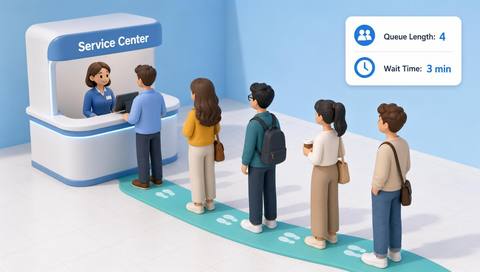
 Without IVISIONStandard CCTV feed
 With IVISIONIllustrative event overlay
The Process
Queue length and waiting time answer different questions. Put a measurable service interval behind discussions about delay.
01Mark where waiting begins and which visible action ends the measured interval.
 02
Assess normal joins, lane changes and departures using representative footage and the supported tracker.
 03
Keep observations without a valid endpoint separate from completed waits. Confirm available reporting fields.
 04
Interpret distributions alongside staffing and service type before changing queue arrangements.
Explore Your Options
| Dimension |  Queue Waiting-Time Estimation |  Queue Length & Wait Time Estimation |
|---|---|---|
| Observation |  Elapsed time between agreed observations associated with a queue journey. | People occupying a defined waiting route. |
| Event criteria | A supported workflow identifies the selected start and endpoint, or reports an incomplete interval. | Supported analysis counts the queue or links waiting-entry and service-exit observations. |
| Monitoring setup | Define queue entry, service start, abandonment handling, reporting period and association limits. | Confirm queue geometry, abandonment and service-point definitions. |
| What it cannot establish | Hidden joins, lane switching, occlusion and early departures can break association. An observed interval may exclude waiting outside coverage. | Cannot infer customer satisfaction or measure unseen waiting accurately. |
| Practical outcome | Separates service delay from the number of people currently standing in a queue. | Help service teams assess bottlenecks with measurable queue context. |
Illustrative demonstration
Example footage and simulated events explain the review workflow. They do not measure detector performance.
 Sites overview
No matching events.
People CountingPlaces waiting intervals alongside the separate queue-size observation.
Read More
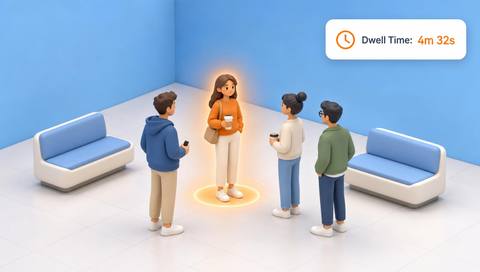 People Counting
General zone residence may include activity beyond waiting for service.
Read More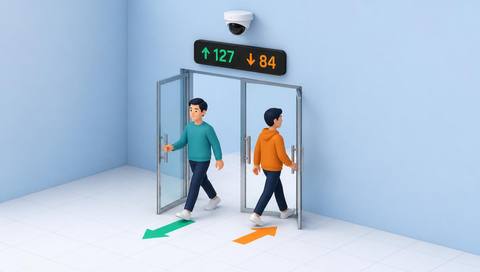 People Counting
Passage totals describe arrivals and departures rather than service duration.
Read MoreEXPLORE WHAT’S POSSIBLE
01 / 04 · QUEUE WAITING-TIME ESTIMATION
A short line can stall during a complex transaction.
Example event: Completed observed waits lengthen without a large queue count.
Operator response: A supervisor checks service context and decides whether assistance is needed.
Practical value: Delay is distinguished from queue size.
Discuss this capability02 / 04 · QUEUE WAITING-TIME ESTIMATION
Customers sometimes leave the line before reaching service.
Example event: A journey ends without the configured service observation.
Operator response: Treat it as an incomplete or departure case if supported, not a completed service wait.
Practical value: The report avoids presenting abandoned journeys as served visitors.
Discuss this capability03 / 04 · QUEUE WAITING-TIME ESTIMATION
People switch lanes outside part of the camera view.
Example event: The association between start and service becomes uncertain.
Operator response: Flag the coverage limitation and validate a different camera arrangement.
Practical value: Measurement quality is checked before staffing conclusions.
Discuss this capability04 / 04 · QUEUE WAITING-TIME ESTIMATION
Cover the relevant queue-entry and service endpoints with an appropriate association workflow.
Visibility: Lane changes, barriers and crowd occlusion can interrupt observation.
Configuration: Confirm temporal association, endpoint handling and report support; do not infer waiting time from headcount alone.
Privacy: Prefer anonymous journey identifiers and retain only the information needed for the service question.
Human review: Operators should validate intervals and exceptions before using aggregate waits for performance decisions.
Discuss this capabilityFrequently asked questions
Estimates an observed interval between defined queue-entry and service or exit observations.
No. It lacks the entry and service timing needed to measure an individual observed interval.
At the agreed observable boundary. Time spent outside that coverage is excluded unless another validated source covers it.
Confirm whether the deployment can mark a departure or incomplete interval. Do not automatically treat it as service completion.
An average can hide variation and missing observations. Review the available distribution, sample size and exceptions as well.
Find your fit
Separates service delay from the number of people currently standing in a queue. For Service operations managers, Retail supervisors, Transport service teams.
Workflow to discuss
Queue Waiting-Time Estimation + Distinguishes slow service from a large queue.
Discuss a camera view, a monitoring question and the review process your team needs.