Download IVISION Catalog

 01
Prepare the view
Define a justified investigation scope and period.


Linking unknown observations can create a persistent personal record even without a name. Confirm necessity, authority and retention before deployment, and require each association to remain reviewable rather than implying a verified person or continuous presence.
Catalog workflow. Confirm detector availability, permitted use and event delivery for the proposed deployment. Website examples are illustrative.
Assess unidentified-history governance

 Without IVISIONStandard CCTV feed
 With IVISIONIllustrative event overlay
The Process
A history of candidates is not a known identity Avoid turning uncertain links into personal facts.
01Define a justified investigation scope and period.
 02
Validate the available association method on relevant footage.
 03
Review each proposed link and retain uncertainty.
 04
Discard unsupported associations and apply the approved retention process.
Explore Your Options
| Dimension |  Creation of visit histories for unknown or unidentified individuals |  Known-person and unknown-person classification |
|---|---|---|
| Observation |  Candidate sightings proposed to relate to the same unidentified subject. | A face observation with or without an accepted profile association. |
| Event criteria | A verified re-identification method suggests a repeat association. | A supported matcher applies validated acceptance criteria. |
| Monitoring setup | Confirm authorized purpose, matching method, retention and review. | Confirm profile population, threshold and ambiguous-match handling. |
| What it cannot establish | Cannot prove identity, intent or that similar sightings belong to one person. | Cannot establish legitimacy, threat or whether someone has visited previously. |
| Practical outcome | Clarify the evidence and privacy limits of repeated-sighting analysis. | Make matching state explicit without judging the person. |
Illustrative demonstration
Example footage and simulated events explain the review workflow. They do not measure detector performance.
 Sites overview
No matching events.
Face RecognitionUnderstand the original unresolved matching state.
Read More
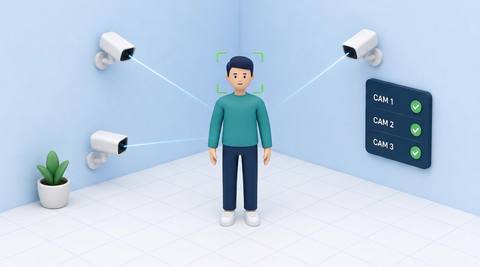 Face Recognition
Assess the separate association method.
Read MoreFace RecognitionHandle an individual unmatched arrival without persistent profiling.
Read MoreEXPLORE WHAT’S POSSIBLE
01 / 04 · CREATION OF VISIT HISTORIES FOR UNKNOWN OR UNIDENTIFIED INDIVIDUALS
Several unresolved sightings may be unrelated.
Example event: A repeat candidate is proposed.
Operator response: Compare source evidence before linking.
Practical value: Avoids mistaken histories.
Discuss this capability02 / 04 · CREATION OF VISIT HISTORIES FOR UNKNOWN OR UNIDENTIFIED INDIVIDUALS
Clothing changes across observations.
Example event: The association becomes uncertain.
Operator response: Keep records separate unless supported.
Practical value: Preserves evidence quality.
Discuss this capability03 / 04 · CREATION OF VISIT HISTORIES FOR UNKNOWN OR UNIDENTIFIED INDIVIDUALS
A proposed history exceeds its purpose.
Example event: Long-lived unidentified profiles accumulate.
Operator response: Narrow scope and retention before use.
Practical value: Prevents unnecessary tracking.
Discuss this capability04 / 04 · CREATION OF VISIT HISTORIES FOR UNKNOWN OR UNIDENTIFIED INDIVIDUALS
Use only approved source cameras.
Visibility: Appearance similarity and image quality limit links.
Configuration: No operational unidentified-history engine was verified.
Privacy: Require purpose, retention and access review before deployment.
Human review: Confirm every link and remove unsupported associations.
Discuss this capabilityFrequently asked questions
A proposed workflow for linking unconfirmed sightings into a reviewable visit history without assigning a verified identity.
No. Persistent movement histories can still concern identifiable people.
No. It is a candidate association.
No. Repeated presence does not establish motive.
No blanket tracking is justified by this catalog entry.
Find your fit
Clarify the evidence and privacy limits of repeated-sighting analysis. For Authorized investigators, Privacy governance teams.
Workflow to discuss
Creation of visit histories for unknown or unidentified individuals + Make repeat links reviewable.
Discuss a camera view, a monitoring question and the review process your team needs.