




Operational visibility
Keep visual evidence supplementary.

Hazardous zones, distant targets and changing weather demand specialist camera suitability and disciplined interpretation.
Explore use casesFind your environment
Choose an environment to see the challenges, actions,
and outcomes that matter there.
Use camera observations as a supplementary source of visible site context around access, routes and selected PPE checks. Process safety, hazardous-atmosphere detection and emergency controls require dedicated approved systems.
 Illustrative observation
 with IVISIONIllustrative overlay
What can Vision AI help you monitor?
Keep visual evidence supplementary.

Connect observations with permit context.

Make specialist verification explicit.
Hazardous zones, distant targets and changing weather demand specialist camera suitability and disciplined interpretation.
Define observations with qualified site specialists.
Check camera suitability and representative conditions.
Treat images as cues for qualified verification.
Work permissions vary by task.
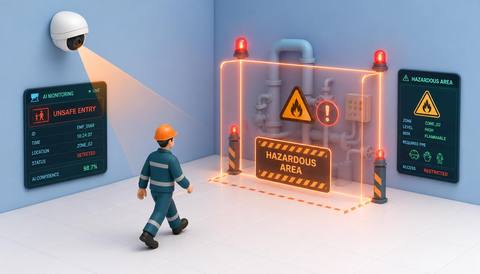
Observation: A candidate boundary entry occurs.
Response: Verify permits and apply the site procedure.
Value: Provide location context.
PPE appearance needs task-specific interpretation.
Observation: A supported PPE condition is flagged.
Response: Qualified staff inspect equipment and requirements.
Value: Focus a safety check.
A patch or plume has uncertain meaning.
Observation: A candidate visible anomaly appears.
Response: Use approved sensors and inspection procedures.
Value: Locate an investigation without diagnosing a leak.
Camera view: Use site-approved installation and equipment for the classified area.
Validation: Validate detector support under weather and process conditions.
Privacy: Restrict sensitive infrastructure and worker imagery.
Human review: Qualified process-safety personnel determine hazards and action.
No. Invisible gases require appropriate dedicated detection.
No. Substance and hazard assessment need suitable instruments and procedures.
No. Approved safety systems remain essential.
No. Suitability, condition and correct use need qualified checks.
See it in action
Illustrative observationSurface candidate entry into an area designated hazardous by the site.
Scenario selector
Review candidate entry at a site-designated boundary.
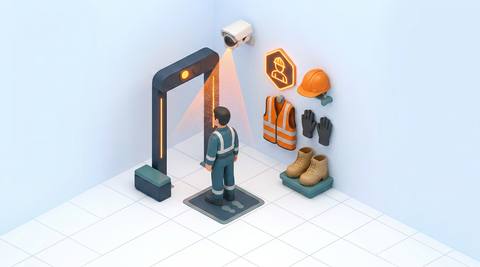
Check supported visible PPE conditions with qualified personnel.
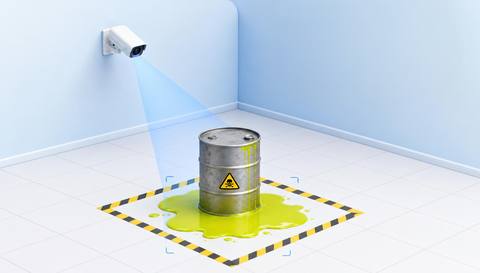
Review a visible anomaly without assuming substance identity or hazard level.
Fit with your environment
Industrial district
No events match this filter.
Use case finder
Tell us about your environment, priority, and cameras. We’ll shape a practical starting point in three steps.
Question 1 of 3
Prefer to look around first? See every use case we offer

Discuss a camera view, a monitoring question and the review process your team needs.

 Sites overview
 3 illustrative sites